Sgyrsiau Cwrwgl // Coracle Conversations
Efo’r Eog Doeth // hosted by the Salmon of Knowledge

Cyflwyniad
Cynhelir ein Sgyrsiau Cwrwgl yn yr Oracl Cwrwgl Conwy neu o'i gwmpas, gan Eog Doeth.
Mae'r Eog yn ganllaw trosiadol ac ymarferol ar gyfer y sgyrsiau, gan ein hannog i "aros gyda'r llif" wrth archwilio cymhlethdodau ein perthnasoedd â dŵr. Y cyfan sydd ganddynt yw ein bod yn dod â chwilfrydedd, agoredrwydd, a pharodrwydd i ddysgu oddi wrth ein gilydd.
Ar y dudalen hon gewch chi wybod am sgyrsiau a gynhaliwyd hyd yn hyn, a sut mae'r sgyrsiau'n gweithio.
Os hoffech chi gael Sgwrs Coracle, neu enwebu eraill i wneud hynny, fasen ni wrth ein bodd yn clywed gynnoch chi!
Anfonwch e-bost at Lindsey (ysgrifennydd Eog)
Introduction
Our Coracle Conversations are hosted in or around the Conwy Conversational Coracle, by the Salmon of Knowledge.
The Salmon is a metaphorical and practical guide for the conversations, encouraging us to "stay with the flow" while exploring the complexities of our relationships with water. All they is that we bring curiosity, openness, and a willingness to learn from each other.
On this page you’ll find out about conversations held so far, and how the conversations work.
If you would like to have a Coracle Conversation, or to nominate others to do so, we’d love to hear from you!
Please email Lindsey (Salmon secretary)
Beth sydd wedi cael ei drafod? // What has been discussed?
Yn yr enghreifftiau isod, welwch chi fod sgyrsiau’n canolbwyntio ar bob math o bethau – o faterion sy’n peri pryder, i syniadau, a gobeithion a breuddwydion ar gyfer y dyfodol. Mae rhai o'r sgyrsiau wedi'u hysbrydoli gan y cwestiynau y mae pobl wedi bod yn eu gofyn i’r dyffryn.
In the examples below, you’ll find that conversations focus on all sorts of things - from issues of concern, to ideas, and hopes and dreams for the future. Some of the conversations are in response to the questions people have been asking the valley.
-
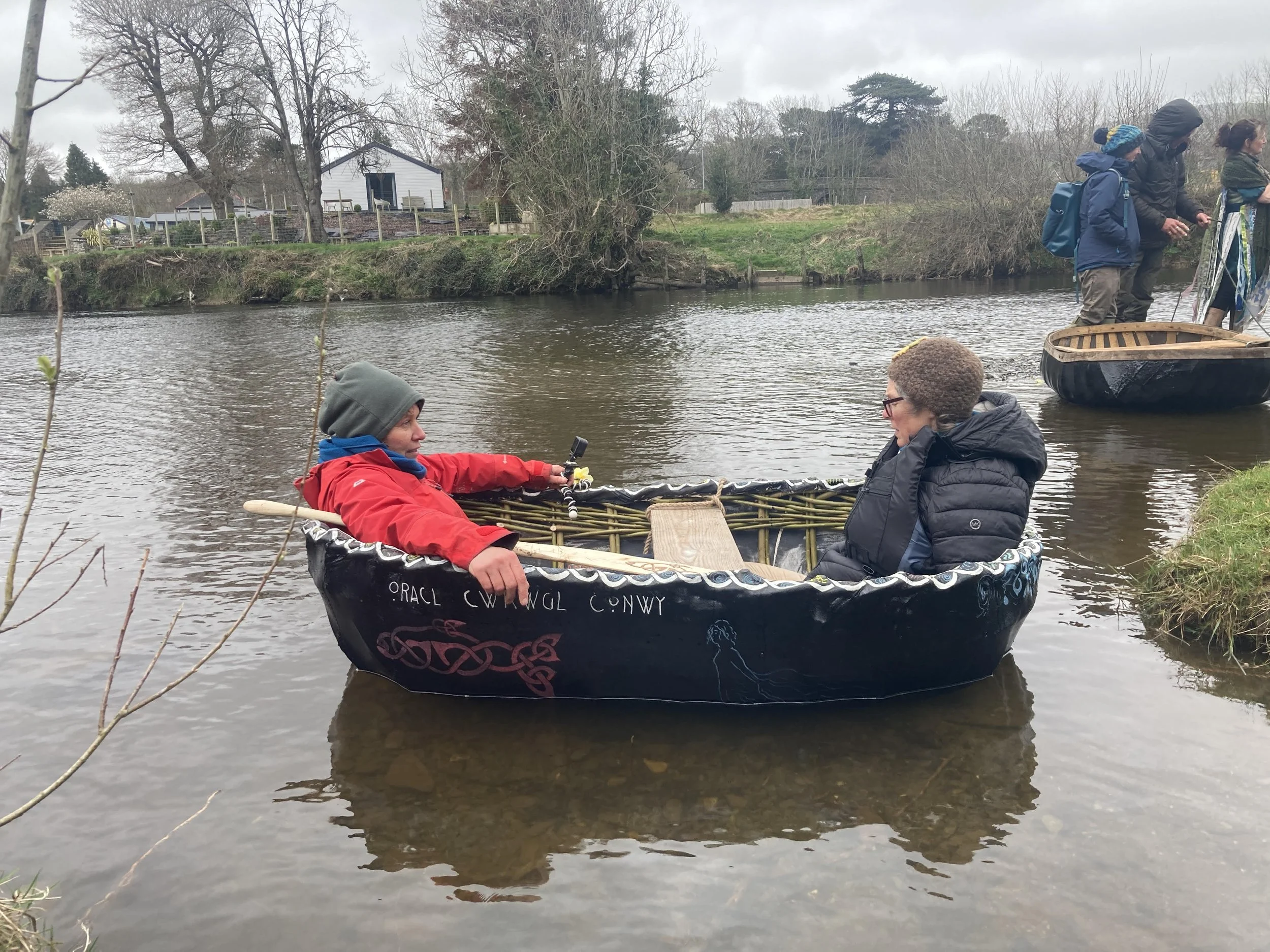
Lindsey + Katie
THE CORACLE AS A SPACE FOR CONVERSATION
Lindsey and Katie hold the first coracle conversation, at the launch of Oracl Cwrwgl Conwy. They discuss how cosy it feels in the coracle and how to use the space and seat to support good conversations.
WISHES
To be able to have a cup of tea while in the coracle!
That the coracle becomes a symbol as well as a practical tool for freshwater conversations - perhaps in situations of conflct - in the Conwy Valley.
-
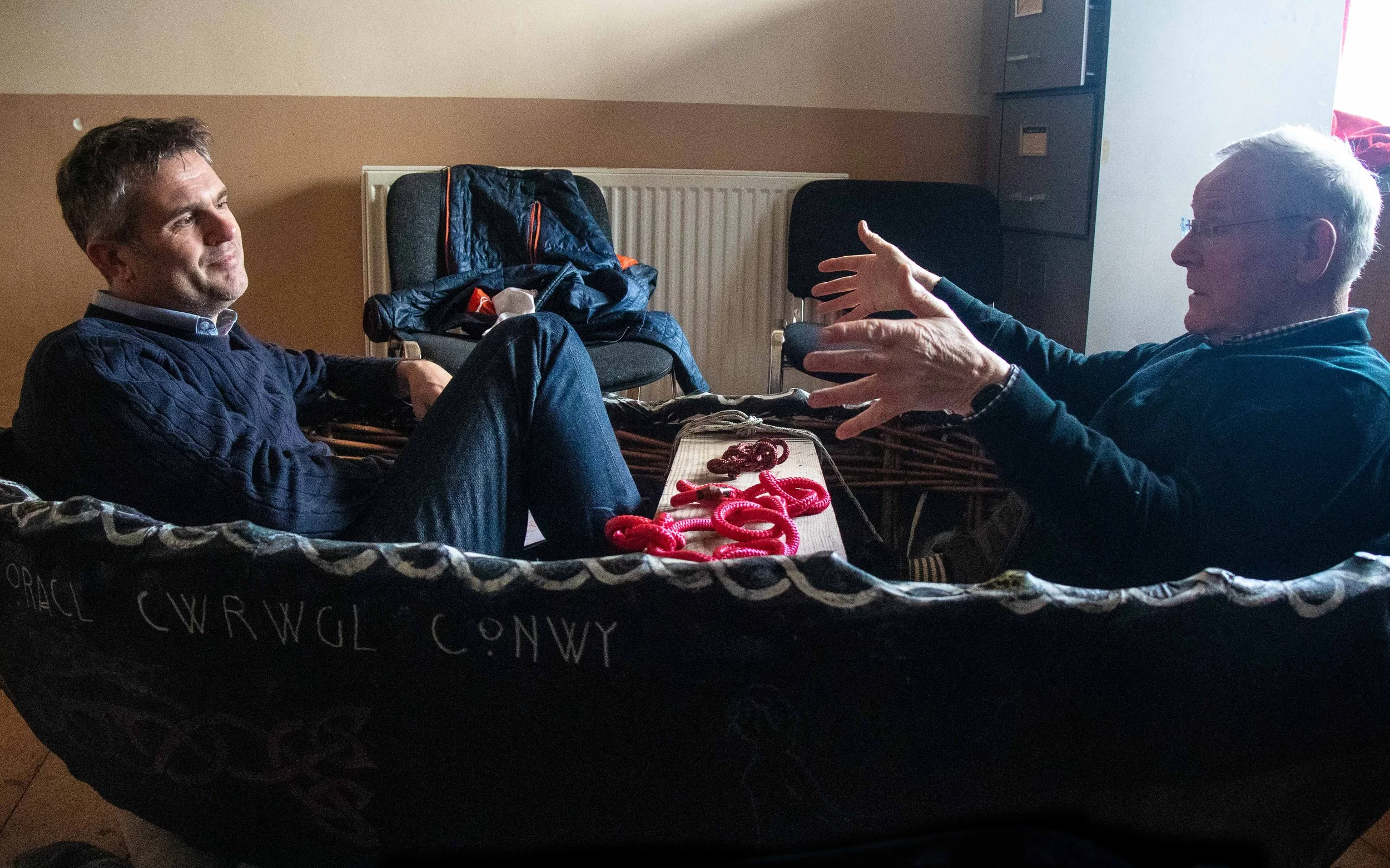
Craig + Chris
HOW THE ENVIRONMENTAL MOVEMENT HAS LOST CONNECTION WITH COMMUNITY
Chris Baine and Craig Bennett discussed the evolution and challenges of the environmental movement. They explore the shift from community-driven environmentalism and partnership approaches to urban conservation in the 1970s, to professionalized NGOs in the 1990s and problems with competition between organisations and loss of community involvement. They consider the potential now for bringing together professionalism AND bottom-up community engagement in order to work more effectively to restore rivers and wetlands.WISHES
Chris wished for a visual/auditory journey which would increase public understanding of the interconnections along the Conwy Valley, while Craig advocated for rivers as the backbone of nature restoration..
-

Elowen + Lindsey
THE VALLEY JOURNEY OF A WATER MOLECULE
14-year old Elowen reflects with Lindsey on the symbolic and practical aspects of water. They imagine the journey and experience of water molecules, and their transformation from water to gas and back again as they travel down the valley. They reflect on the resilience of water, its interconnectedness with everything and its ability to adapt.WISHES
Elowen wishes to visit every spring in the Conwy Valley
-
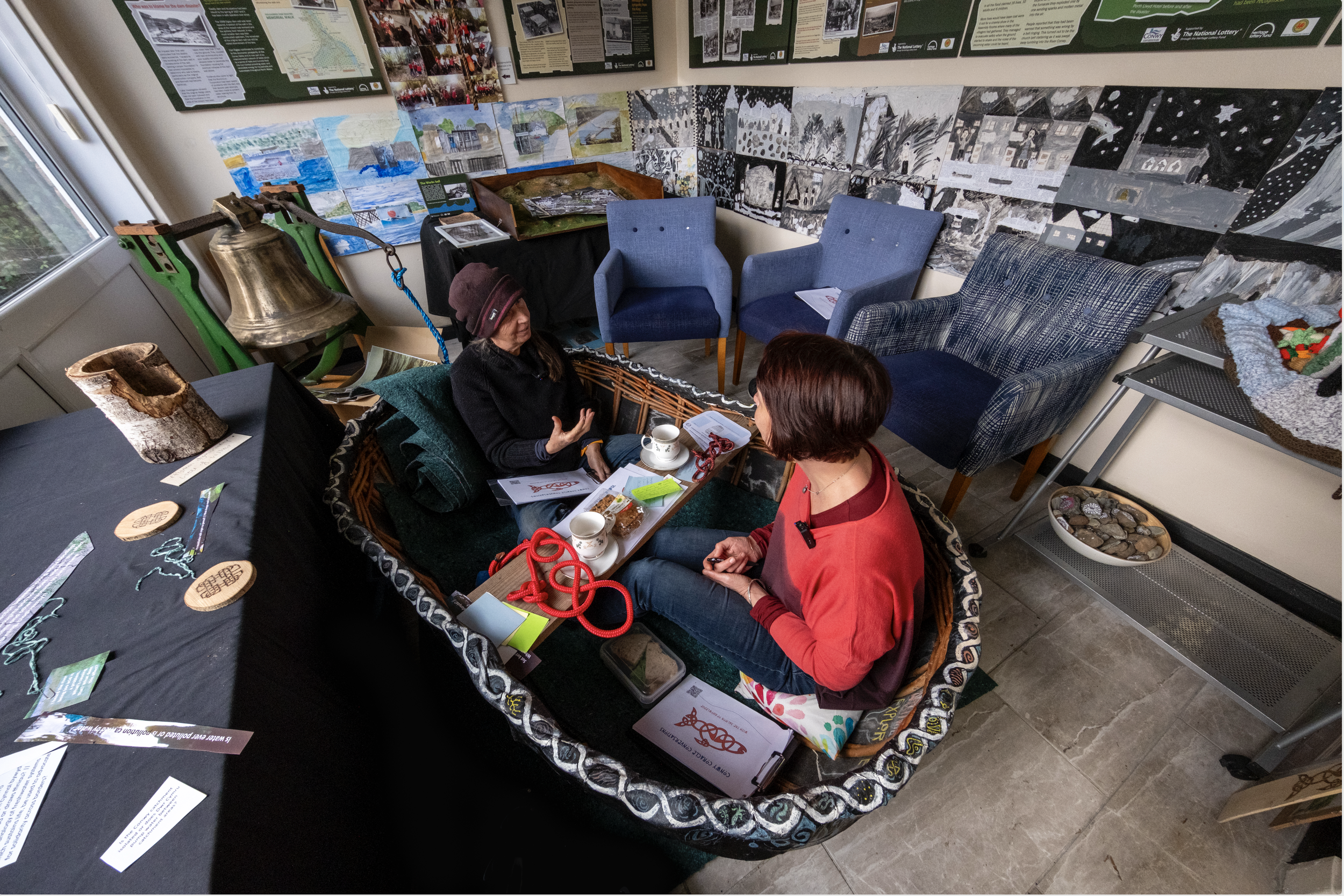
Victoria + Lindsey
LEARNING TO LIVE ALONGSIDE, AMONGST AND IN SOLIDARITY WITH HEALTHY FRESH WATER
Victoria talks of how she was originally drawn to Gofod Glas as an opportunity to think about the river and our relationships with freshwater in a different way. She feels strongly about the precarious nature of our contemporary relationship with water, and our separation from it, compared to the old, indigenous ways.
Victoria and Lindsey agreed that the one thing that’s for certain is that we can’t continue like this. And they share stories - from their own experience, the past, and other areas of the world - that more reciprocal relationships are not only possible but already happening.
Victoria describes the power of her freshwater swimming experiences: the suspension and immersion and a feeling of losing her outer limits so she becomes part of the water; tasting and sensing waters in different lakes and rivers in the Conwy Valley, including water coming from bedrock that is so sweet that it almost tastes like it has sugar in it.
They go on to discuss some of the Gofod Glas questions, and what could be done.
WISHES
Further conversations to envisage/imagine a new relationship with water in the future, taking into account our modern needs and the needs of a fresh, life sustaining river. What does that look like? What steps would we have to take to get there?
-
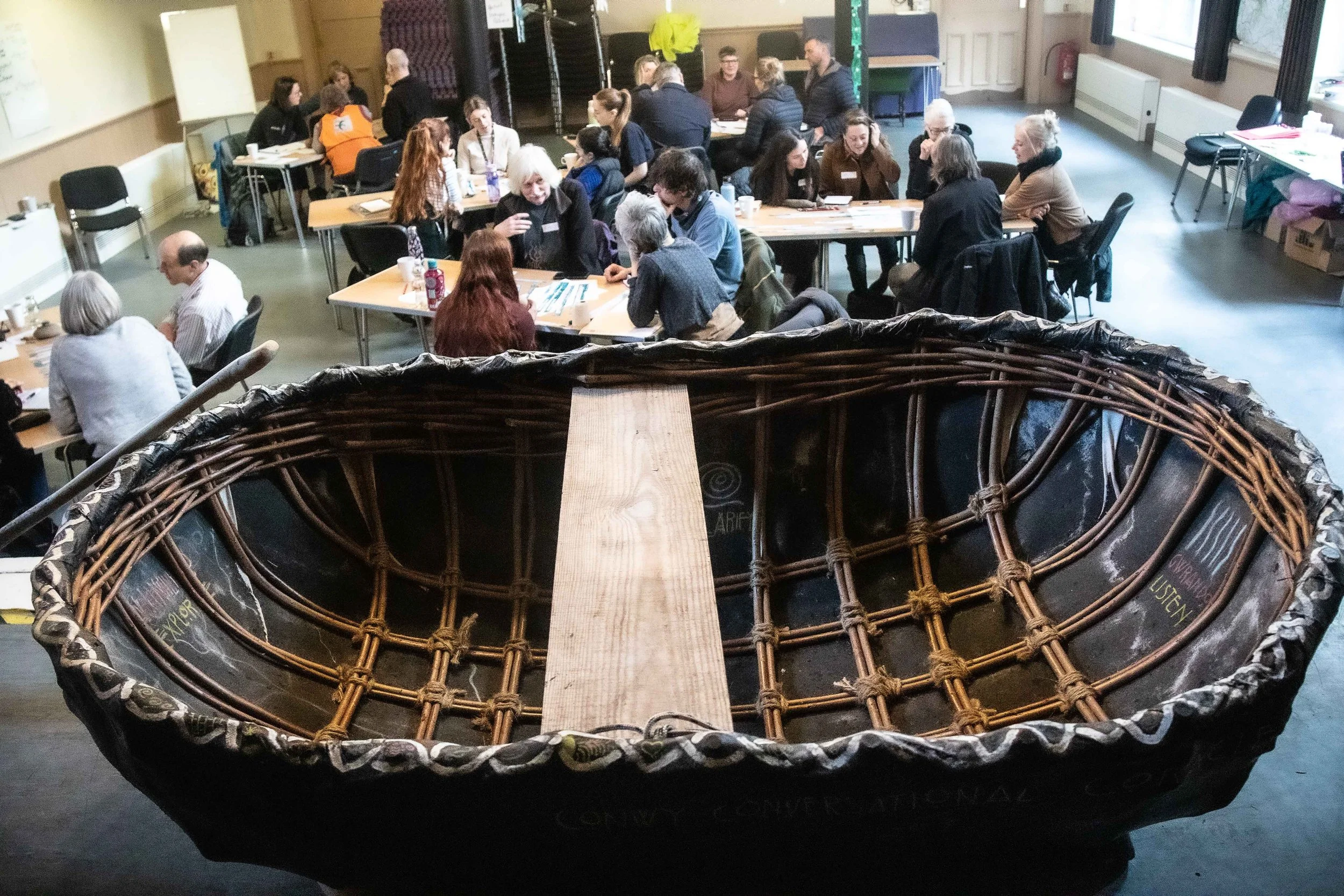
Llifo Conwy
CONSIDERING THE GOFOD GLAS QUESTIONS
Llifo Conwy worked through all the Gofod Glas questions, and tried arranging them - through discussion and negotiation - on a line from ‘straightforward/easy to answer’ to ‘difficult/complex’ to answer.
Of course, some questions initially thought to be straightforward to answer, others thought were more complex. And some felt that the positioning depended on your point of view - perhaps an organisation might think something is sorted, but a community might not. The questions to the river provoked the biggest range of opinions.
The 7 ‘easiest’ to answer questions:
What’s the longest river in the valley?
Is there any support to build a pond or get a water butt?
Where is the best place to watch the salmon leap?
How many springs are there feeding the Conwy valley? Which are the cleanest? Which taste the best?
[To the river]: do you want to have rights?
Where are the worst pollution problems?
What can we do about tourists/vans/human waste in Dyffryn Mymbyr?
[40 questions in the middle]
The 6 ‘most complex’ questions:
What are the politics of freshwater, the power-dynamics, the impact of continued colonial legacy and assumptions?
How can we change the system? Where does the power lie?
How do we make information more accessible and interesting?
[to the river}: Do you want to have rights?
What stories and lives have been hidden in places like wetlands, and are now being lost and/or revealed?
How does commercial forestry affect water quality? Do we even need commercial forestry anymore?
-
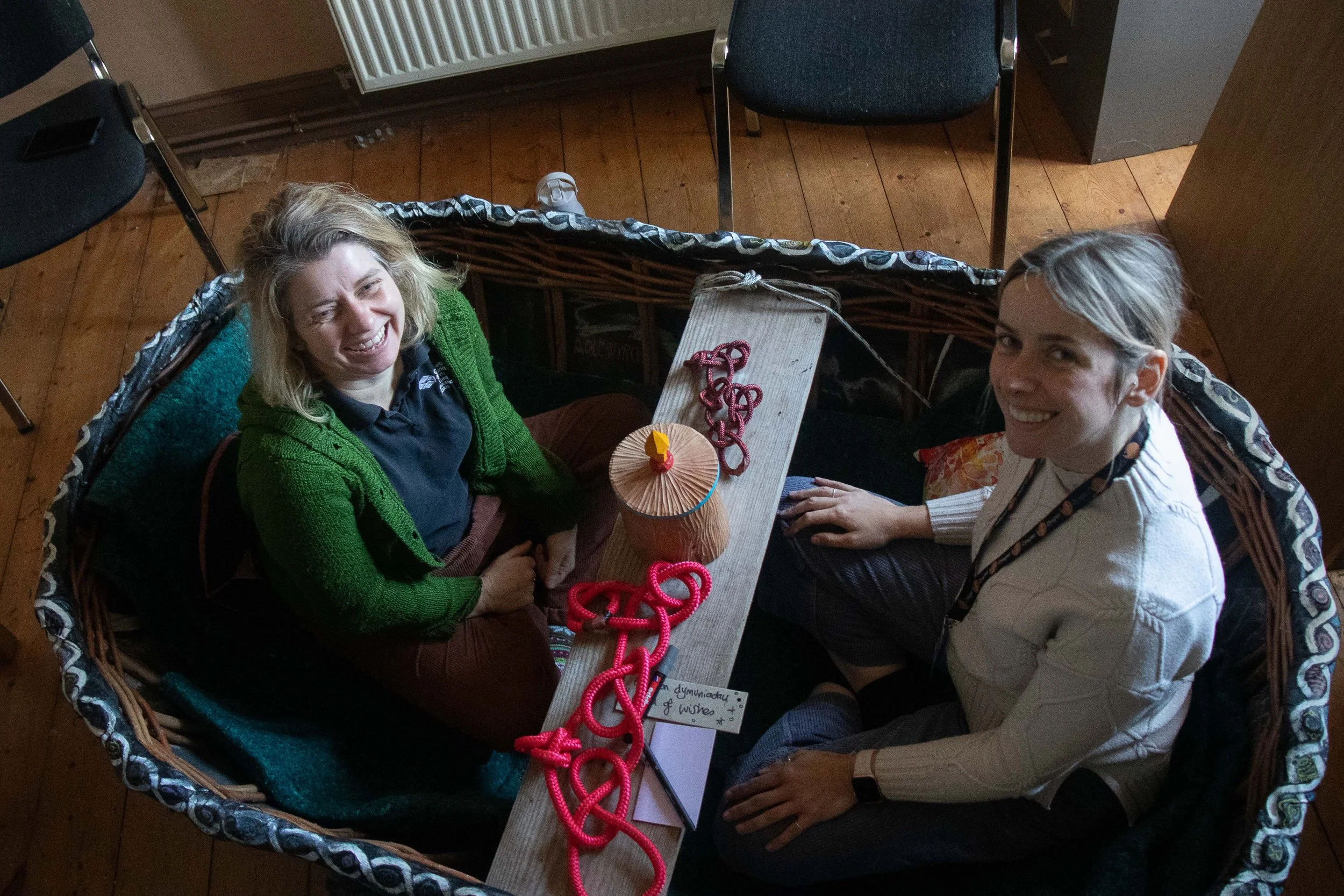
Emily + Bev
THE NEED FOR MORE INNOVATIVE, EMPATHIC AND HOLISTIC WATER MANAGEMENT
Emily and Bev had a wide-ranging and personal conversation about the emotional, philosophical and practical dimensions of freshwater stewardship. They shared stories of their professional work in the field, personal experiences and deep emotional connections to freshwater environments. Exploring examples of working with farmers to reduce livestock access to rivers and decreasing nutrient pollution, personal experiences of sewage flooding and concerns about swimming in potentially polluted rivers, they discussed the limitations of current data-driven and regulatory approaches, and the need for more innovative, empathetic, and holistic ways of thinking about water management.
WISHES
For stronger connections between people and rivers, in both in their professional work and in the wider community.
For a deeper, more intuitive understanding of rivers—imagining what it would be like if rivers could communicate their needs directly.
-
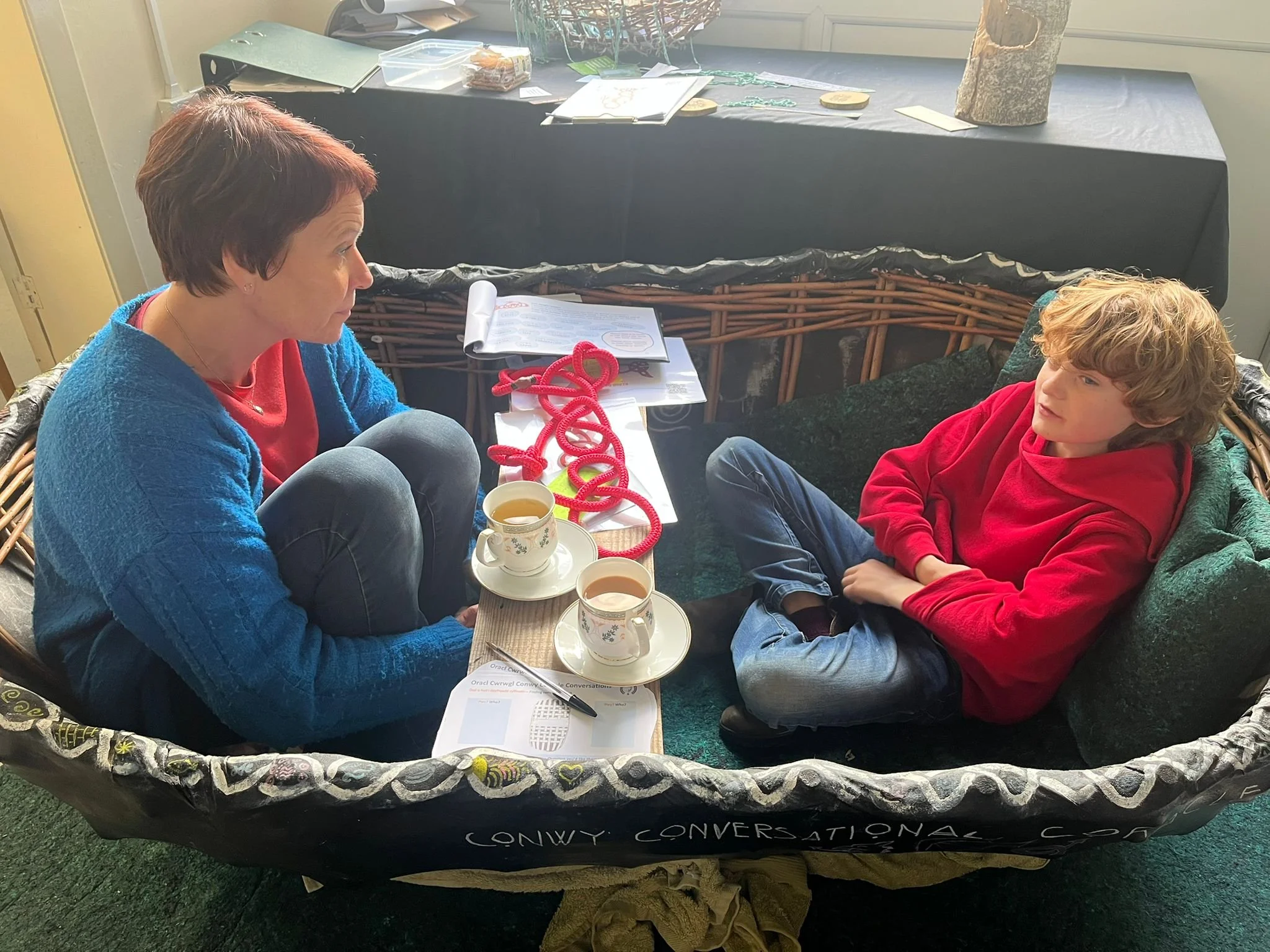
Iago + Lindsey
BEING FISH AND RIVER
Iago shares his favourite place to swim in Afon Llugwy near Capel Curig. He loves the sun shining on the water. When he jumps in the water it makes him feel happy. This makes the water feel happy too, and the water gives a thank you by making the water warmer for him.
He likes wearing goggles to see the fish and everything under the water. The fish are like family - they understand him. They don’t swim away when he goes in the water, and he loves it when they tickle his legs. It makes him like he’s the king fish.
He imagines how it is to be a fish: “We feel safe in the water, and like to go on ledges and in different directions, exploring places we’ve never been. We need to have rocks and stones to hide in when things come that might want to eat us. We don’t need much from humans, so we don’t usually go to them because we like deep waters, while humans go to the edge to catch us. Humans are affecting the water, putting bottles and throwing things in the water. David Nash’s wooden ball doesn’t affect us though - it makes us smile because it looks pretty and we like it.”
To answer some of the questions that people have asked the river, Iago imagines that he is the river. “It’s tiring to have such a long body, going down the valley bump, bump, bump. But my arms can change directions, and I like it when my legs go faster, in a thunderstorm (although splashing on the rocks really hurts). I says thank you to humans who swim in me and who say thank you to me.”
WISHES
For further conversation with the animals that live in the sea, and how do they feel about people.
-
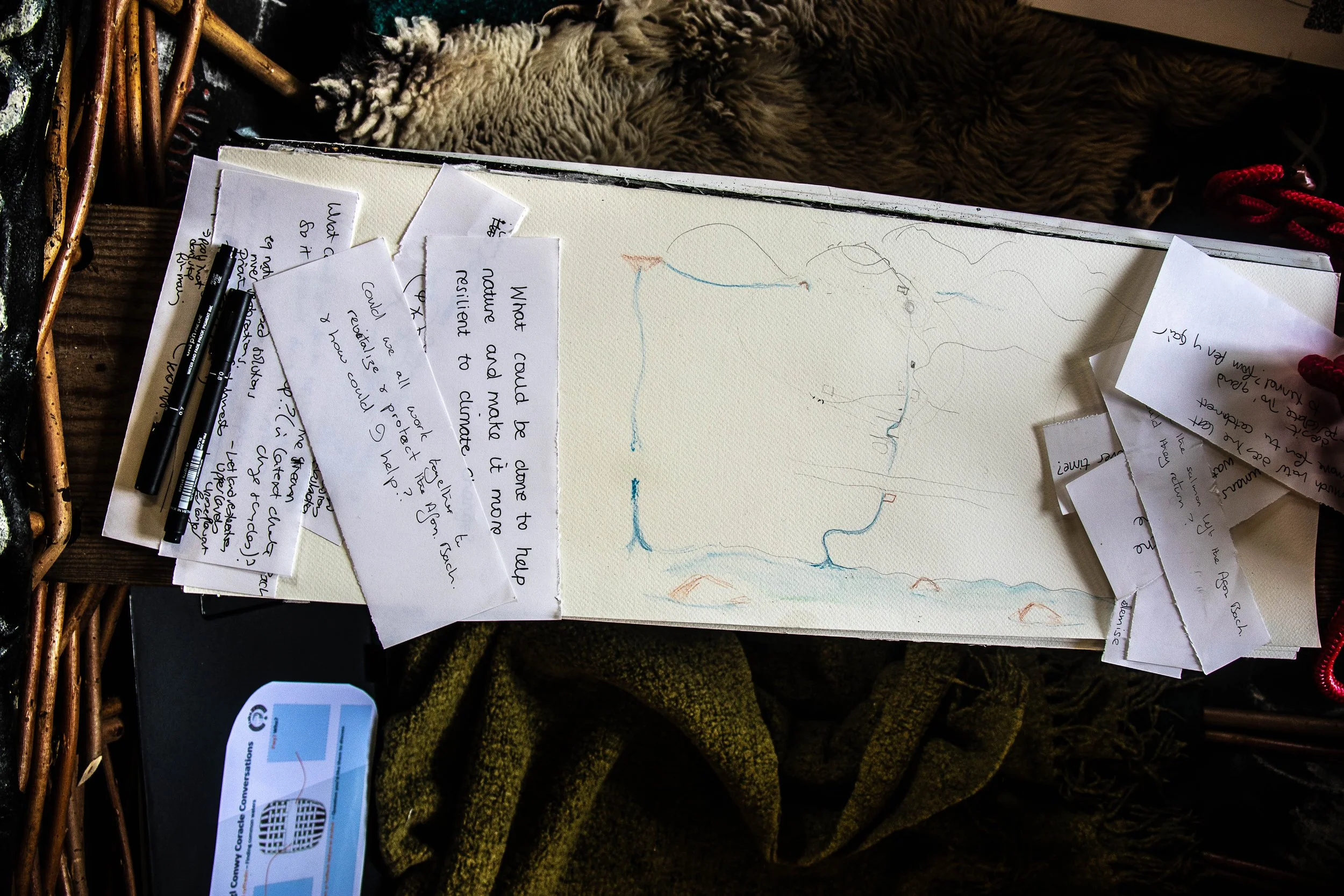
Liz + Jenny
WHY HAS THE AFON BACH STARTED TO RUN DRY?
Concerned and saddened by its demise, Liz wonders how could we protect the Afon Bach so it’s life force continues to be in our community?
Liz and Jenny explore what has been affecting the Afon Bach, and come up with a series of questions that they’d like to find answers to:
How have humans altered the landscape and water over the years?
How is climate change impacting the Afon Bach?
Why have the salmon left the Afon Bach and could they return?
Could we all work together to revitalize and protect the Afon Bach and how could I help?
They end by sharing ideas of what could we do to support the stream so it doesn’t dry up (in the context of climate change and cycles) eg nature based solutions; river restoration; could wetland restoration on upper levels support base flows for longer; ‘leaky dams’/pools that don’t stop fish moving.
WISHES
I wish that we can minimise and adapt to climate change so that there is enough water to sustain people and nature in this catchment and the wider Conwy/Cymru
My wish would be for us to work together to restore/improve the Afon Bach and surroundings to enable salmon and other species to use it again and in the future
-
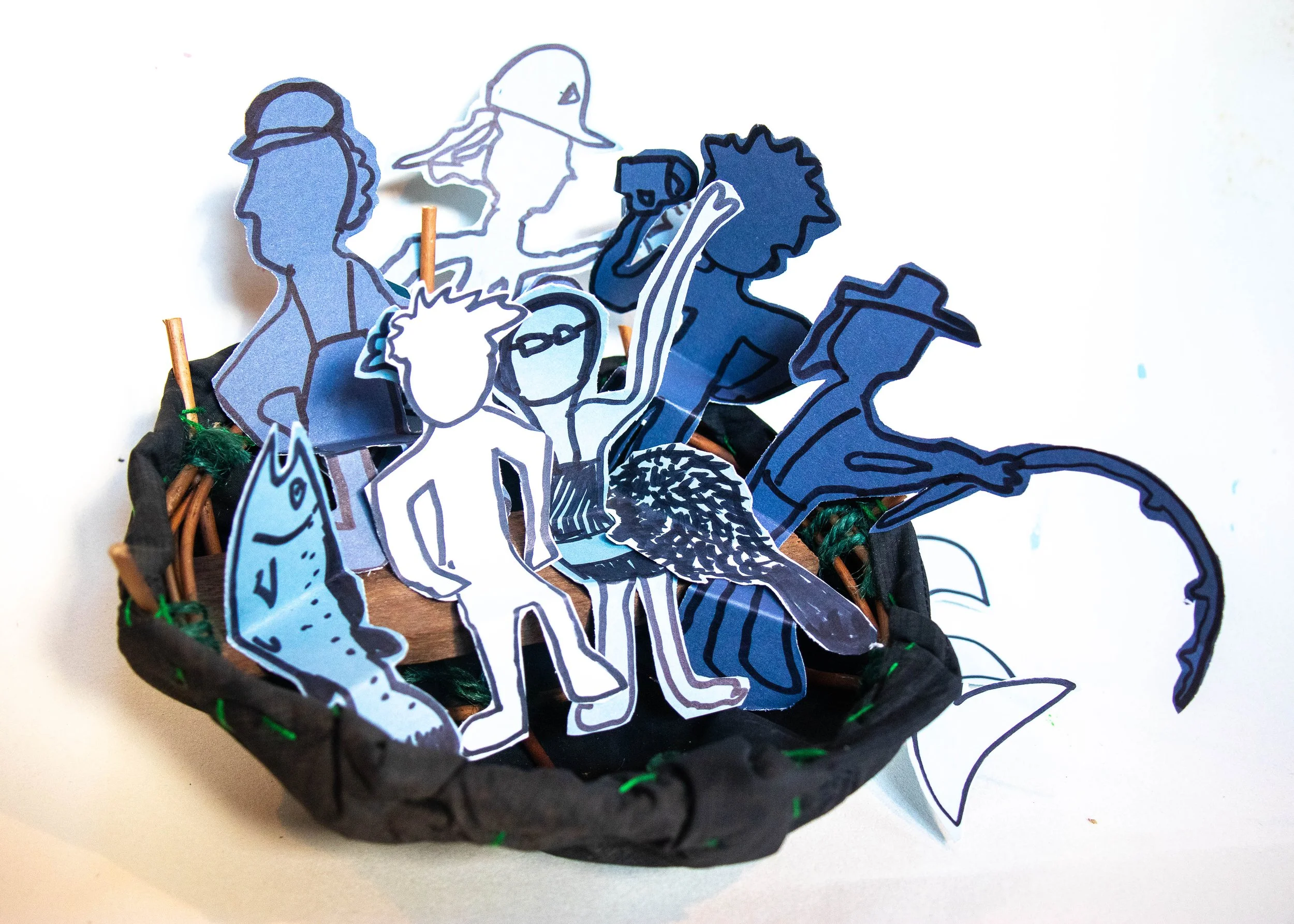
Richard + Justin
BUILDING TRUST AND HONEST CONVERSATIONS WITH FARMING COMMUNITIES
Richard and Justin consider the complexities of working with farming communities on issues of nature recovery and sustainable water management, recognising some farmers perceive nature recovery initiatives as accusatory or as a critique of their stewardship.
Is it possible to change the narrative to one that recognizes the interconnectedness of nature, livelihoods, and community resilience, emphasizing that long-term sustainability requires solutions that benefit both the environment and rural economies?
They discuss the need to shift away from rigid, top-down approaches towards personal relationships, peer-to-peer learning, careful negotiation, flexibility and a willingness to engage in open, sometimes difficult, conversations.
-
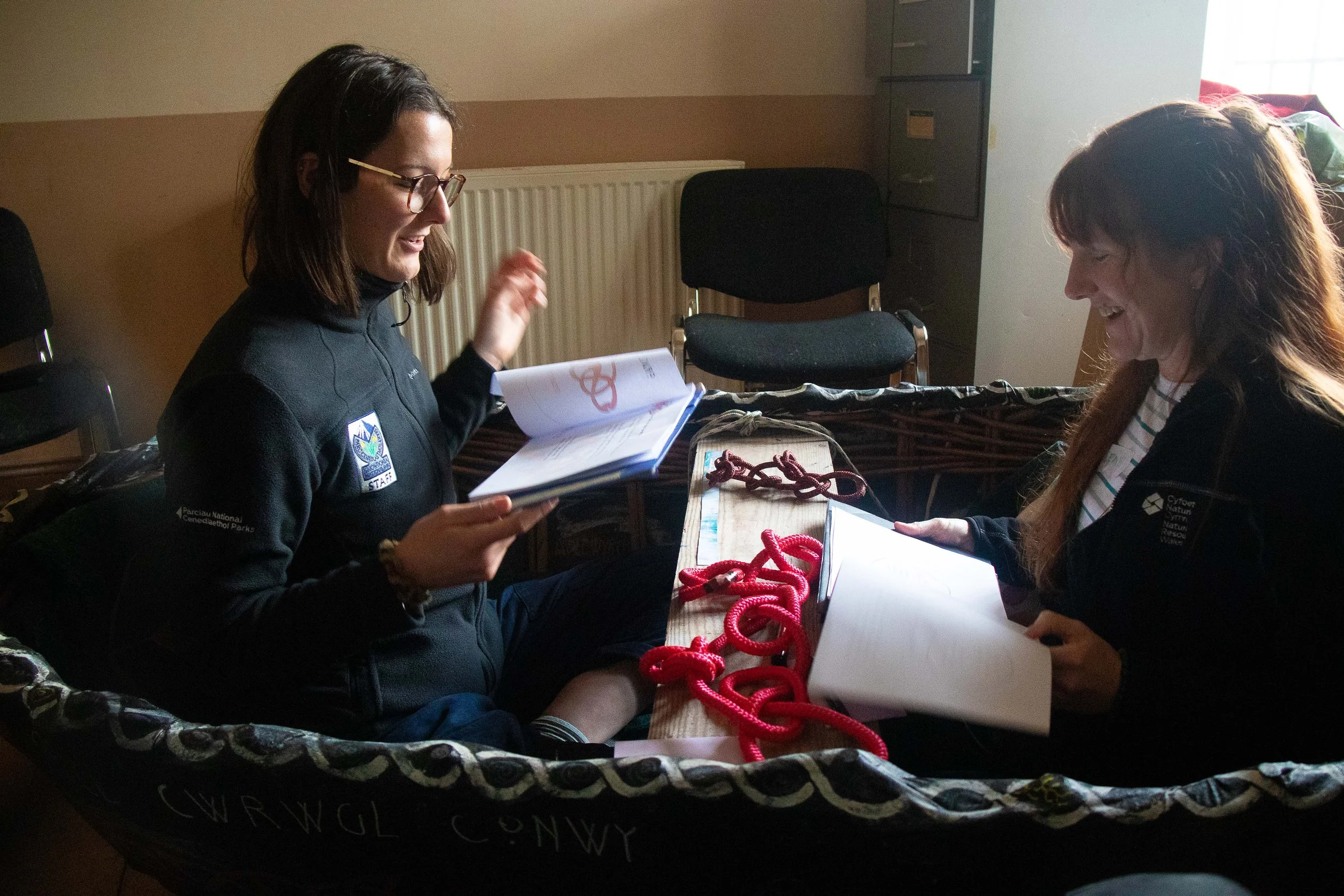
Megan + Jenny
WHAT CAN I DO?
Megan and Jenny chose to discuss one of the Gofod Glas questions - What can I do? They discussed the challenges of trying to work out what they - and others - can do as individuals, and in community, within the context of the big systemic issues such as embodied water, that affect use, levels and quality of freshwater. Ideas included saving water at home and ‘water literacy training’ (eg where does your tap water come from?), to field days and experiences introducing freshwater conservation to young people and students. They discussed the importance of building emotional connections with freshwater, as well as practical things you can do (how not to pollute water if you go swimming, how to live more sustainably) and sharing opportunities to work in the sector.
-
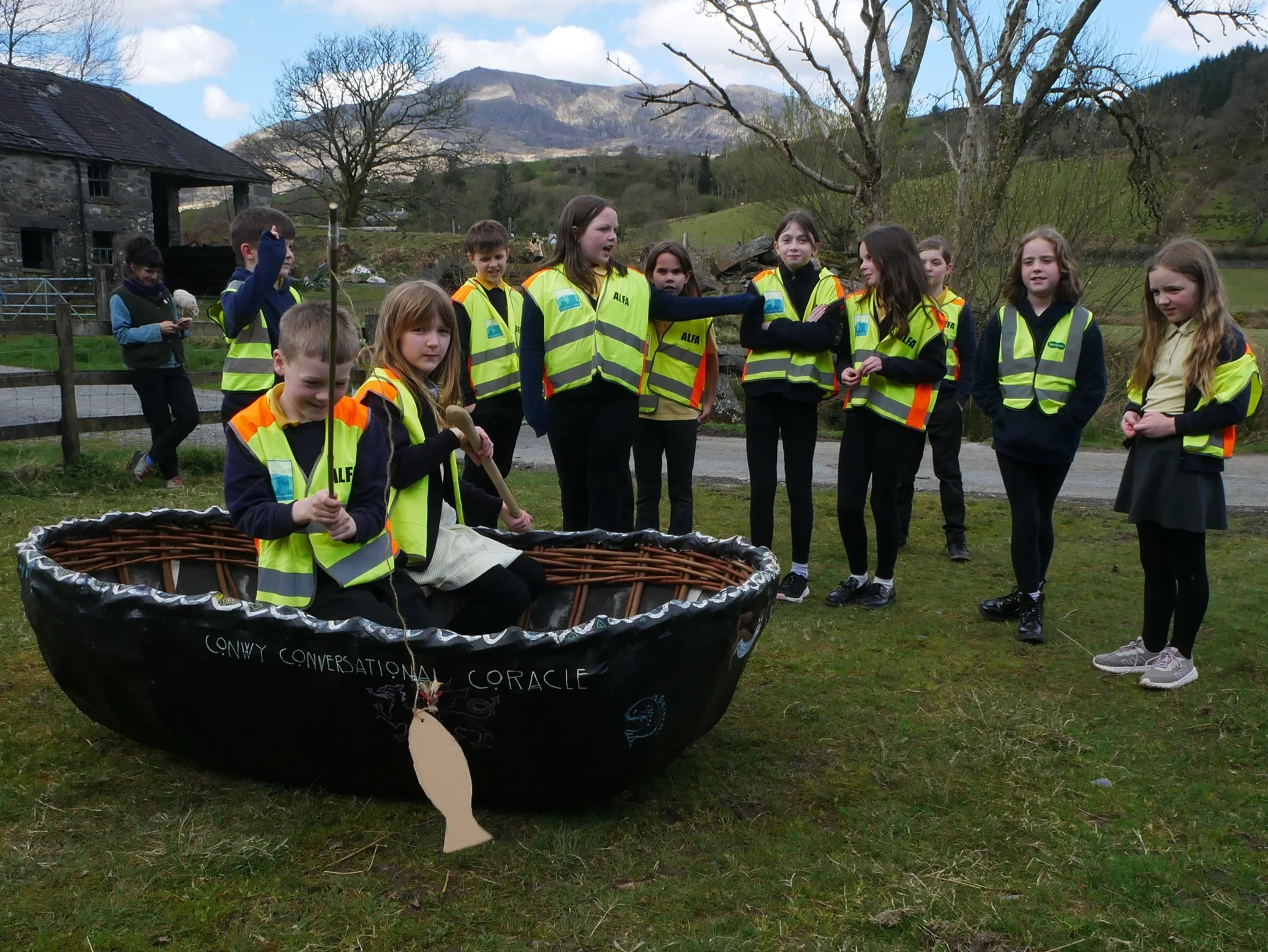
Ysgol Dolwyddelan
BE DAN NI ISIO? WHAT DO WE WANT?
Parch i’r Afon - respect for the river!
Afonydd iach - clean waters!
Mwy o bysgod - more fish!
-
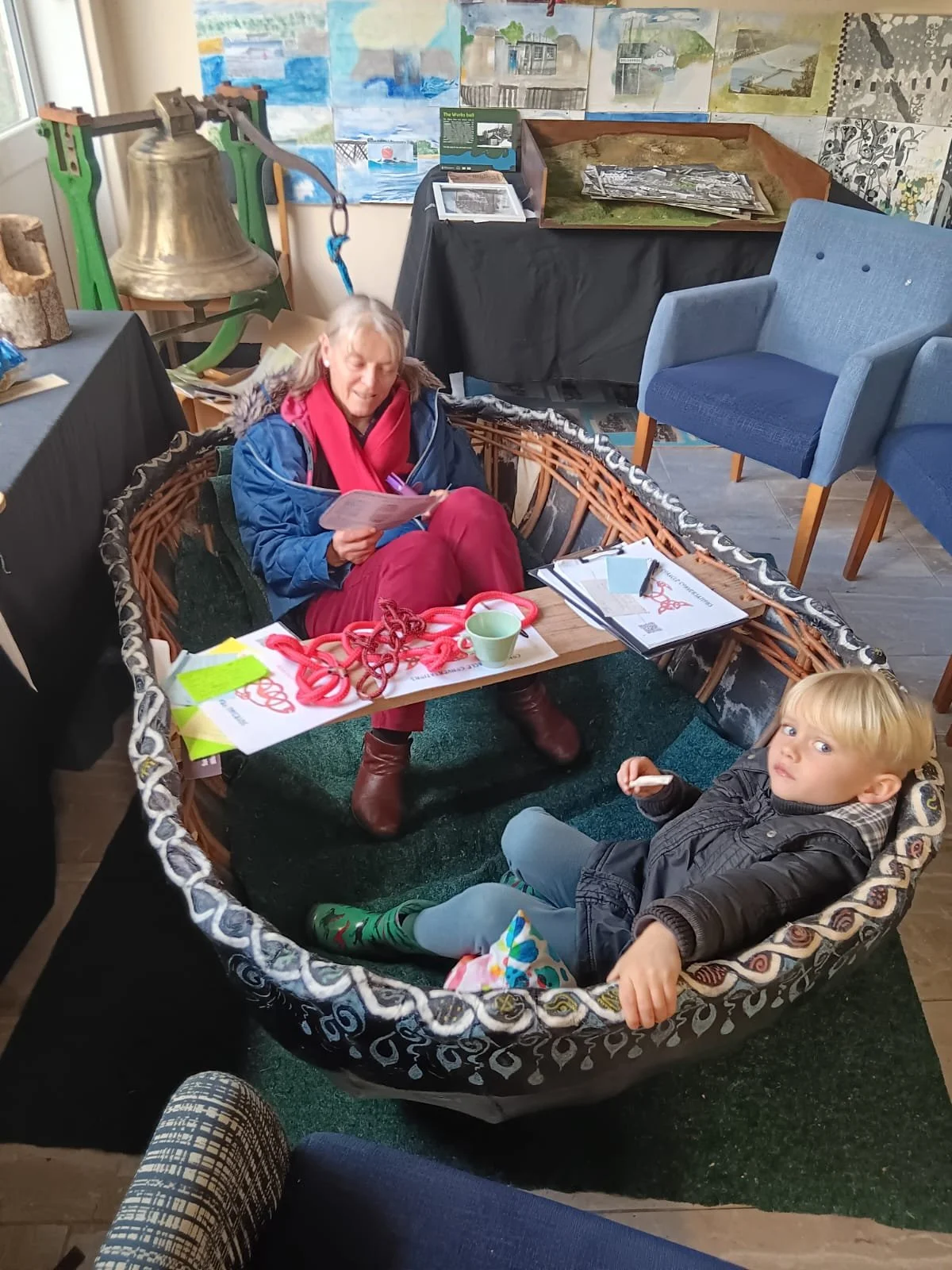
Heather + her grandson
CORACLE CONVERSATION NOMINATIONS
Sut mae o’n gweithio? // How does it work?
Sut beth yw'r sgyrsiau?
Mae'r sgyrsiau'n amrywio o 20 munud i 2 awr. Weithiau maent yn ysgafn eu calon, yn hwyl ac yn ddychmygus. Weithiau maent yn ffordd o ddod o hyd i ffyrdd newydd o edrych ar rywbeth neu benderfynu arno lle mae gwahanol farnau neu syniadau.
Mae Eog Gwybodaeth* yn cynnig dau fath o brofiad cwrwgl:
Archwiliad agored
Gweithio trwy fater neu gwestiwn penodol
Efallai y bydd y rhain ar dir sych, mewn adeilad cymunedol neu wrth ymyl afon. Neu, os yw'r tywydd yn caniatáu, gallant ddigwydd ar bwll, rhan gysgodol o afon neu lyn.
Fel arfer, mae sgyrsiau'n digwydd rhwng dau berson (neu efallai un person dynol ac un person mwy-na-dynol - efallai Afon Conwy eu hunain).
Mae pobl yn cymryd rhan fel unigolion, yn hytrach nag fel cynrychiolwyr sefydliad. Dyma un o 5 egwyddor sy'n arwain ein sgyrsiau (gweler isod am fanylion)
*Cefnogir y sgyrsiau gan Lindsey Colbourne, sydd â 30 mlynedd o brofiad o hwyluso a datrys gwrthdaro.
What are the conversations like?
Conversations range from 20 minutes to 2 hours. Sometimes they are light hearted, fun and imaginative. Sometimes they are a way of finding new ways of looking at or deciding about something where there are different opinions or ideas.
The Salmon of Knowledge* offers two types of coracle experience:
An open-ended exploration
Working through a particular issue or question
These maybe on dry land, in a community building or next to a river. Or, weather permitting, they can take place on a pond, sheltered part of a river or lake.
Conversations usually take place between two people (or perhaps one human person and one more-than-human person - perhaps Afon Conwy themselves).
People take part as individuals, rather than as representatives of an organisation. This is one of 5 principles that guide our conversations (see below for details)
*The conversations are supported by Lindsey Colbourne, who has 30 years of experience of facilitation and conflict resolution.
Adborth // Feedback
“Somehow being in this coracle together makes it feel like it is safe talk about anything”
“I’ll be honest and say I was a bit skeptical at first, avoiding any adversarial point of view. But it was really interesting to explore using the Salmon’s guidelines, to find out that actually we think the same. Listening to your story of how you arrived at where you are now was really interesting to me, because it makes you very human. You are not an organization. you are passionate about how things should be and good be but you are within the confines you are working in. And I’m the same, I’m passionate about my locale.”
“Diddorol iawn. Diolch o galon, Eog Doeth! Swn i'n lico neud o eto, ella ar Llyn Geirionydd tro nesa”
“This is one of the best and most unexpected conversations I've ever had!”
“I remember feeling a bit nervous prior to doing this, but felt at ease as soon as I started chatting in the coracle. It's quite nice keeping the conversation topics broad, leaving room for creative thinking and space for the conversation to go wherever it needs to!”
“Gymaint o stwff yn dod allan o’r sgwrs yma - stwff i ni ystyried, cyferiadau i ni symud ynddo, y dull cwrwgl ac y ffordd mae’r adroddiad yn profi faint mor effeithiol sio yn dal y gofod i bobol ddod at eu gilydd i drafod.”
“It was absolutely brilliant, I’ve found out there are things I can do. I’ve been feeling frustrated and powerless, but now I have a sense of kind of agency over decisions and that is really important.”
Strwythur y sgyrsiau
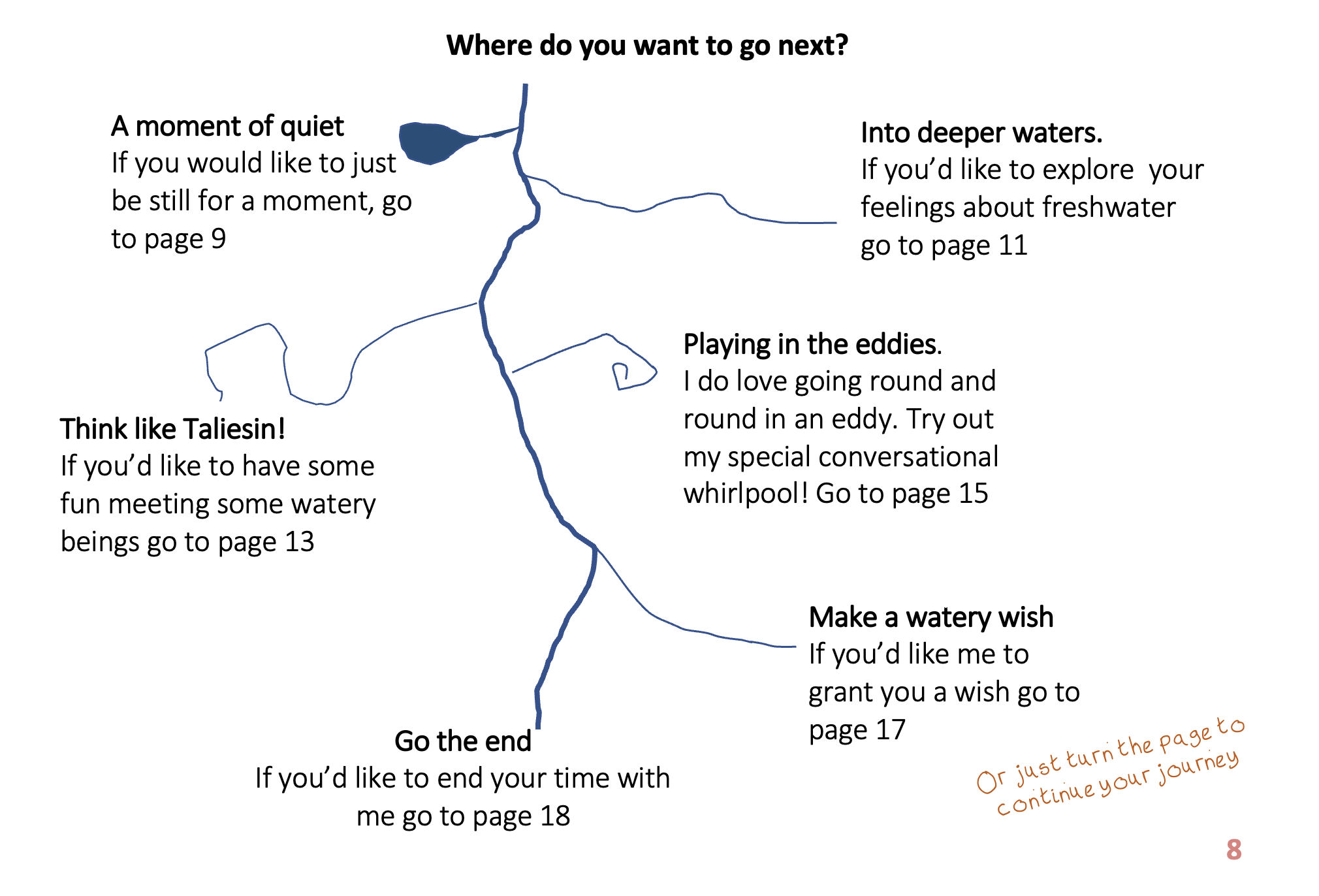
Ar ôl dod yn gyfforddus, byddwn yn dechrau trwy rannu rhywbeth am ein perthynas â dŵr. Os ydych chi ar 'archwiliad agored' gallwch symud ymlaen i archwilio gwahanol agweddau ar eich taith afon gydag Eog Gwybodaeth. Chi sydd i benderfynu ble rydych chi'n mynd!
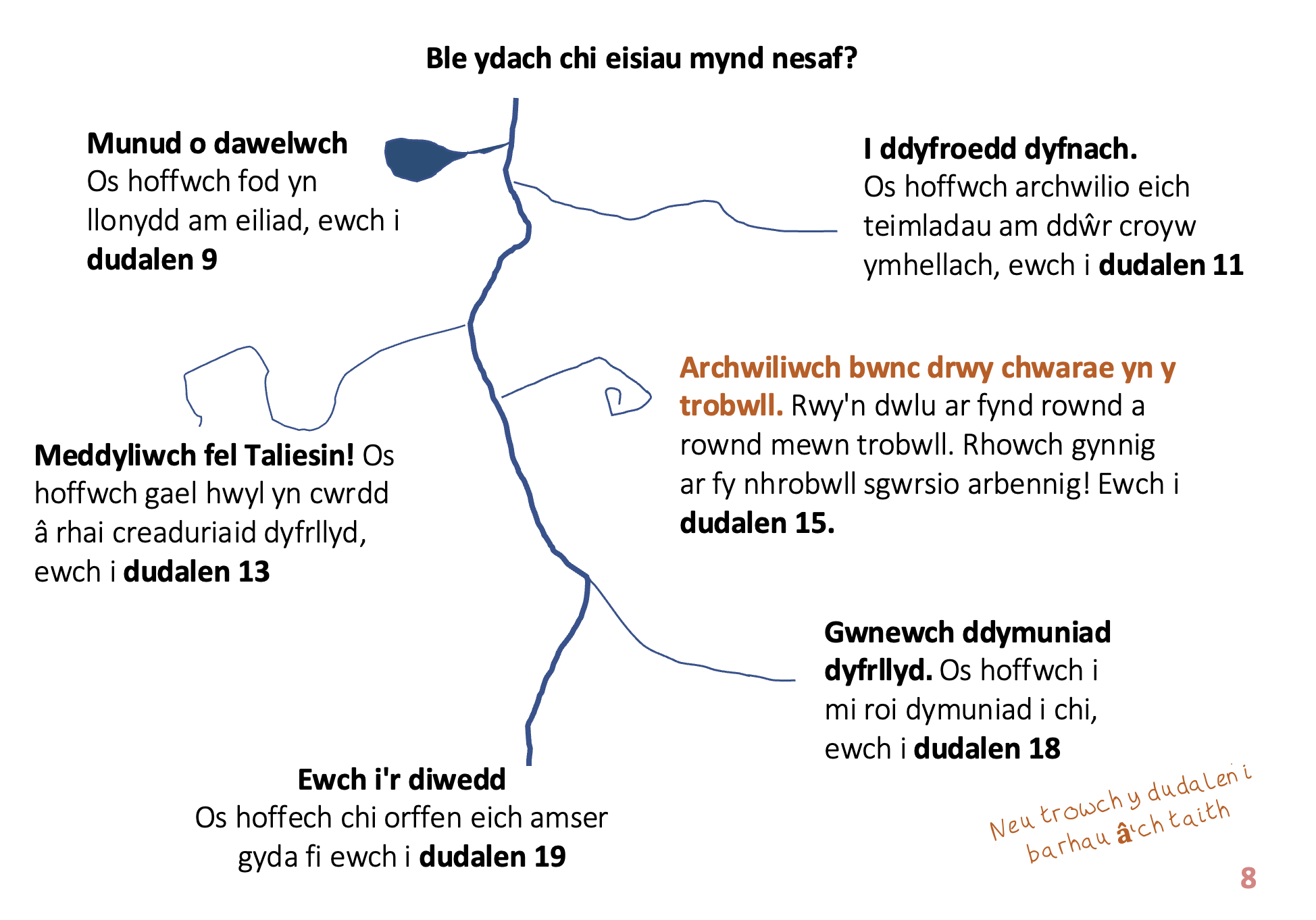
The structure of open-ended conversations
After getting comfortable, we start by sharing something about our relationship with water. If you are on an ‘open-ended exploration’ you can move on to explore different aspects of your river journey with the Salmon of Knowledge. Where you go is up to you!
Strwythur sgyrsiau manwl
Ar gyfer y sgyrsiau mwy manwl, am fater neu bryder penodol, mae'r Eog yn cynnig rhai egwyddorion ar gyfer sgwrs dda. Byddwch yn trafod y rhain cyn dechrau eich Sgwrs Cwrwg
Yna mae ein sgwrs yn dechrau'n ysgafn, gan rannu rhywbeth am eich perthynas â dŵr. Yna rydym yn mapio'r mater yr hoffech ei drafod, a bydd yr eog yn eich tywys trwy rannu eich barn ar wahanol agweddau arno. Yn aml byddwch yn gorffen trwy drafod y camau nesaf.
Ar ôl eich sgwrs, bydd yr Eog Doeth yn cynnig cefnogi'r camau nesaf a rhoi crynodeb o'r hyn a drafodwyd.
Egwyddorion Eog Doeth ar gyfer sgwrs dda
Mae'n rhaid i ni eogiaid archwilio drwy'r amser, er mwyn goroesi. Rydym yn edrych o dan greigiau, yn archwilio llednentydd newydd ac yn gweithio allan sut i oresgyn rhwystrau.
Mi bydda i’n eich gwahodd i ymuno â mi i feddwl fel eog yn ystod ein sgwrs cwrwgl, trwy:
1. fod mor agored â phosibl a mynd gyda'r llif:
Gofyn cwestiynau yn hytrach na gwneud rhagdybiaethau am y person arall, eu barn neu'r materion rydych chi'n eu trafod (beth sy'n sail i'r farn honno? Pam? Pryd yn benodol?)
Ymgymryd ag ymholi (beth yw'r posibiliadau? Sut allwn i edrych ar hyn yn wahanol?)
Ceisio dealltwriaeth yn hytrach na chytundeb (oherwydd gall y dyfroedd rydym yn nofio ynddynt fod yn gymhleth, a gallwn ddysgu llawer o safbwyntiau)
2. Bod yn bresennol heddiw fel unigolyn, gyda phrofiad, yn hytrach na siarad ar ran sefydliad, neu bobl eraill.
3. Rhoi o'r neilltu unrhyw wybodaeth ysgrifenedig hir. Rwy'n eich gwahodd i gyflwyno hyn ar lafar, neu i gyfeirio ato ar ôl ein sgwrs (dydw i ddim yn dda iawn am brosesu gwybodaeth ysgrifenedig!)
4. Os yw'n iawn gyda chi, hoffwn recordio'r sgwrs. Ni fydd hyn yn cael ei rannu mewn unrhyw ffordd, ond bydd yn fy helpu i ailymweld â'r sgwrs gan ei bod hi'n cymryd peth amser i mi ddeall y manylion a'r microbau sy'n hongian o gwmpas yn nyfroedd eich sgwrs.
Rydym yn rhagweld y gallai'r sgwrs hon gymryd hyd at 2 awr.
Gallwch gael seibiant ar unrhyw adeg,
neu galwad am stop ar unrhyw adeg.
The structure of in-depth conversations
For the more in-depth conversations, about a particular issue or concern, the Salmon offers some principles for good conversation. We will check you are OK with these before starting your Coracle Conversation.
Our conversation then starts gently, sharing something about your relationship with water. We then map out the issue you’d like to discuss, and the salmon will guide you through sharing your views on different aspects of it. Often you will end by discussing next steps.
After your conversation, the Salmon of Knowledge will offer to support next steps and provide a summary of what has been discussed.
The Salmon of Knowledge principles for good conversation
We salmon have to explore all the time, in order to survive. We look under rocks, explore new tributaries and work out how to get around obstacles.
I will invite you to join me in thinking like a salmon during our coracle conversation, by:
1. being as open as possible and going with the flow:
Asking questions rather than making assumptions about the other person, their opinions or the issues you are discussing (what underlies that opinion? Why? When specifically?)
Engaging in a spirit of enquiry(what are the possibilities? How might I look at this differently?)
Seeking understanding rather than agreement (because the waters we swim in might be complex, and we can learn a lot from perspectives )
2. Being present today as an individual, with experience, rather than speaking on behalf of an organization, or other people.
3. Put aside any lengthy written information. I invite you to bring this in verbally, or to refer to it after our conversation (I’m not great at processing written information!)
4. If it is ok with you, I’d like to record the conversation. This will not be shared in any way, but it will help me revisit the conversation as sometimes it takes me a while to understand the nuances and microbes hanging about in the waters of your exchange.
We anticipate this conversation might take up to 2 hours.
You can have a break at any point,
or call stop at any point.