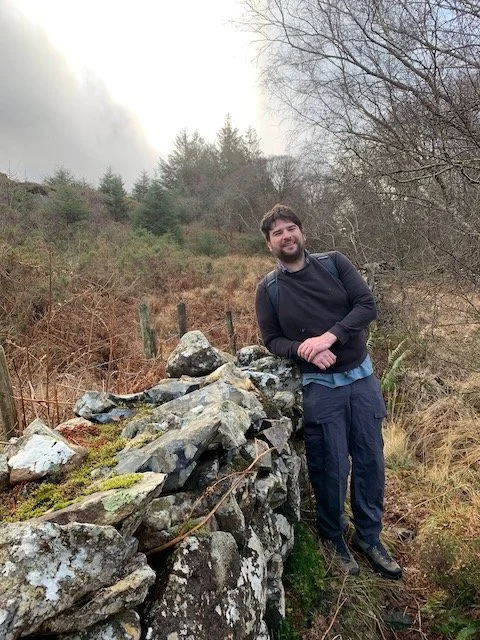
Rhodri Owen: going with the flow in the Conwy Valley
Rhodri Owen has been part of the Gofod Glas creative team since the project began in 2024. Having grown up in the valley, he loves chatting with local residents and hearing their stories, learning more about the community’s connection with the rivers and lakes around him.
We had a chat with Rhodri to learn more about his work with Gofod Glas.
Were you interested in fresh water before you started working with the team?
Not as much as I am now. I grew up on the banks of the River Conwy and, for years, followed its course up and down the valley every day on my way to school or to work in Llanrwst.
I think the water around me has always been there in my subconscious, because the villages and towns along the valley exist because of it. The culture, work and crafts that have existed here are all directly connected to this - from the Migneint down to the sea.
So I approach Gofod Glas from that perspective: people’s relationship with place through their connection with water, and their relationship with water through their connection with place. My interest in “place” has always been there, but through Gofod Glas my interest in fresh water has blossomed.
Can you tell us about the work and videos you’ve created as part of the project?
It has been a slow process at times, and I was trying to tap into this idea of belonging to a place and to water. So I began by getting in touch with four people who have rivers as part of their names, then going for a walk with them to that particular river or lake, interviewing them on video along the way.
I called the video Euarth, Eidda, Llugwy, Serw - after the names of those who took part. I wasn’t really sure what to expect, because it’s quite an unusual question: what is your relationship with water? And there were no wrong answers, of course. It was interesting to hear the different answers and how deep their relationships went.
I then started asking around Dolwyddelan to see whether anyone knew anything about fishing, as it is a longstanding and respected local tradition on the River Lledr, which runs through the village. I was told to ask Eurwyn Pencafna.
I visited Eurwyn and filmed a short conversation while he tied a fishing fly called the Bajar Goch, hoping to return to film more with him. Very sadly, however, he died a few weeks later. His knowledge of the area’s history and fishing was a treasure trove, but I was only lucky enough to hear a small part of it from him.
So, naturally, this film took on a different meaning after Eurwyn’s passing, and the editing reflected that. The film was shown in Dolwyddelan to the Angling Association, sparking further conversations with local anglers.
Protest Cymdeithas yr Iaith 1972
I was also lucky enough to visit the school there to show the films, but also to recreate a protest by Cymdeithas yr Iaith against the purchase of stretches of the river by angling clubs from England, which was pricing local anglers out in the process.
The protest took place in 1972, when people trespassed on the land in question with garden bamboo “rods” with string attached to their ends, pretending to fish. I don’t know whether anything came of it, but the point at the time was that anything that weakens the local culture of a Welsh area, such as fishing, also directly weakens the Welsh language in that area.
So we recreated this with the school and the artist Elly Strigner, creating a protest song, Cân Afon Lledr. We changed Cymdeithas yr Iaith’s original point slightly and asked: if rivers have far fewer fish in them, doesn’t this also impoverish longstanding local culture and consequently mean a decline in the number of Welsh speakers?
The intended journey is from the river’s health to culture, to people, and back to the river’s health. There are more ideas on the way.
Llifeiriant zine with Elin Angharad
Following this work, a zine was created with Elin Angharad, covering some of the research carried out as part of the project. Elin is a zine specialist - zines are multimedia booklets created to share stories, work and creative ideas.
What’s the best thing about working on the project?
I love researching the histories of the areas involved, finding these connections just beneath the surface and creating something around them - reviving things or discovering them afresh. I also love working with the creative team and seeing how their approaches develop throughout the project. We work individually, but our work also feeds into one another’s.
Ideas from the rest of the team include Lindsey Colbourne’s Conversational Coracle, a recreation of a Conwy coracle used as a space for a conversation between two people who might disagree about something, as a way of finding a solution.
Gwisg yr Afon, by Lin Cummins and groups in Dolgarrog and across the valley, keeps growing as more people add questions to the garment to ask the river.
Then there’s a film by David Cleary and a group of young people at Llanrwst Library, created loosely around the story of the Afanc and the children’s relationship with the River Conwy in Llanrwst.
And what’s great is that it’s all starting to flow together, like the upland rivers joining the Conwy.
What’s planned for Gofod Glas in the future?
From my perspective, I want to return to the original film and create something new around it, as well joining Lindsey to build a new coracle with the community in Dolwyddelan.